
多儿在多邻国住。Credit: Duolingo.
Introduction
In October 2023, I undertook learning a language I’d long had reservations about studying: Mandarin Chinese. I was adverse to the language’s tonal system, to say nothing of the difficulty involved in learning its characters. With my boyfriend’s encouragement, though, I decided to dive in and began the course offered through Duolingo.
This past month (March 2025), I finished the course. It’s been an enlightening experience — I’ve learned I actually really enjoy Chinese. I’ve made food I didn’t know about before because I learned about it on Duolingo. I pick up and understand bits of Mandarin conversation from neighbors and people in the street here in Pittsburgh. I’ve expanded my learning methods to podcasts and TV shows, and my boyfriend and I have discussed traveling abroad with this Mandarin knowledge under our belts. I regret having been hesitant about trying Chinese, and I’m looking forward to continuing my learning now that I’ve finished the Duolingo course. But if you’re thinking about learning Mandarin too, is Duolingo right for you?
A little background on me: I’m a native American English speaker who’s been using Duolingo since 2012 — basically since it was first released. Besides Chinese, I’ve finished the courses on Spanish, French, and Norwegian (before more content was added to each course). I’ve seen countless changes in Duolingo’s service in the last decade-plus — some good, some less so. I’ve tried out just about every available course, including Japanese (whose basis in the same complex characters as Chinese was a massive leg-up for me here).
This is not a review of learning Chinese. This is not about how the grammar differs and doesn’t from English (though I was surprised to learn how much it doesn’t). This is not going to be my recommended ways to learn the tones, how I practice hànzì, or what festivals and dishes I learned about along the way. Rather, this is a review focused on my user experience of Duolingo Chinese. With any language-learning method, you are learning the method as well as the language, and if the method is a poor fit for you, you’re not going to get far in the language. That’s why I believe it’s worth thinking about how we learn what we learn.
I do have a lot of complaints with my experience on the app. Some of these are specific to the Chinese course. Some are Duolingo-wide. Many of them are complaints shared by friends and family of mine also using Duolingo. However, I believe the positives still outweigh the negatives when it comes to using Duolingo, and I can attest to having used it to build a basis for myself in Mandarin.
Now, let’s get into it.
The bad
Duolingo courses outside Spanish, French, and to lesser extents German and Italian suffer compared to these Western Indo-European benchmarks. These were some of the earliest languages available to learn on Duolingo, and it’s easy to see why they were chosen from the start: They have an obvious base of Western English-speaking learners, and they are all pretty closely related to English. Having a large basis for early-stage growth makes sense from a business standpoint, while starting with these languages (which share many grammatical, lexical, and cultural foundations with English) makes app development itself easier.
As Duolingo has grown, though, and more languages have been added, the development team has failed to maintain a consistent experience across each. I feel this going between the Chinese and French courses. Duolingo French has interactive “Stories,” specialized grammar exercises, CEFR Score-tracking, and many other advanced features. Nothing like this is available to Chinese learners. French lessons have a ton of variety in writing and speaking opportunities, making Chinese feel years out of date. Japanese and Korean also lack many of these features (though I can attest to Japanese at least having Stories). This comes despite Chinese, Japanese, and Korean ranking among the top-ten most-studied languages on Duolingo for years. While each of these courses has seen improvements over time, they cannot yet compare to the experience a user has learning Spanish, for instance.
I single these three East Asian languages out not only for their geographic relation, but also because many of the complaints I have for the Chinese course are not limited to this course. I groaned when frustrations I’ve had for years with Duolingo Japanese cropped up while studying Chinese. It’s like a cancer that has spread in more neglected parts of the app, metastasizing and eroding at the gamified experience I’ve been sold on. These courses are newer, meaning the team has had less real time to think through instruction issues. But these languages are also hilariously unlike English, to the point where I have been studying Japanese and French on and off for the same 15+ years and still struggle to translate an average sentence in the former — a problem I do not have with the latter.
Teaching Mandarin Chinese is hard. I recognize that. And I appreciate how much of the language I’ve been able to learn through Duolingo in just over a year. Still, the experience has often been painful, and I want to highlight why — especially if you’re used to Duolingo en español.
Repetition does not legitimize
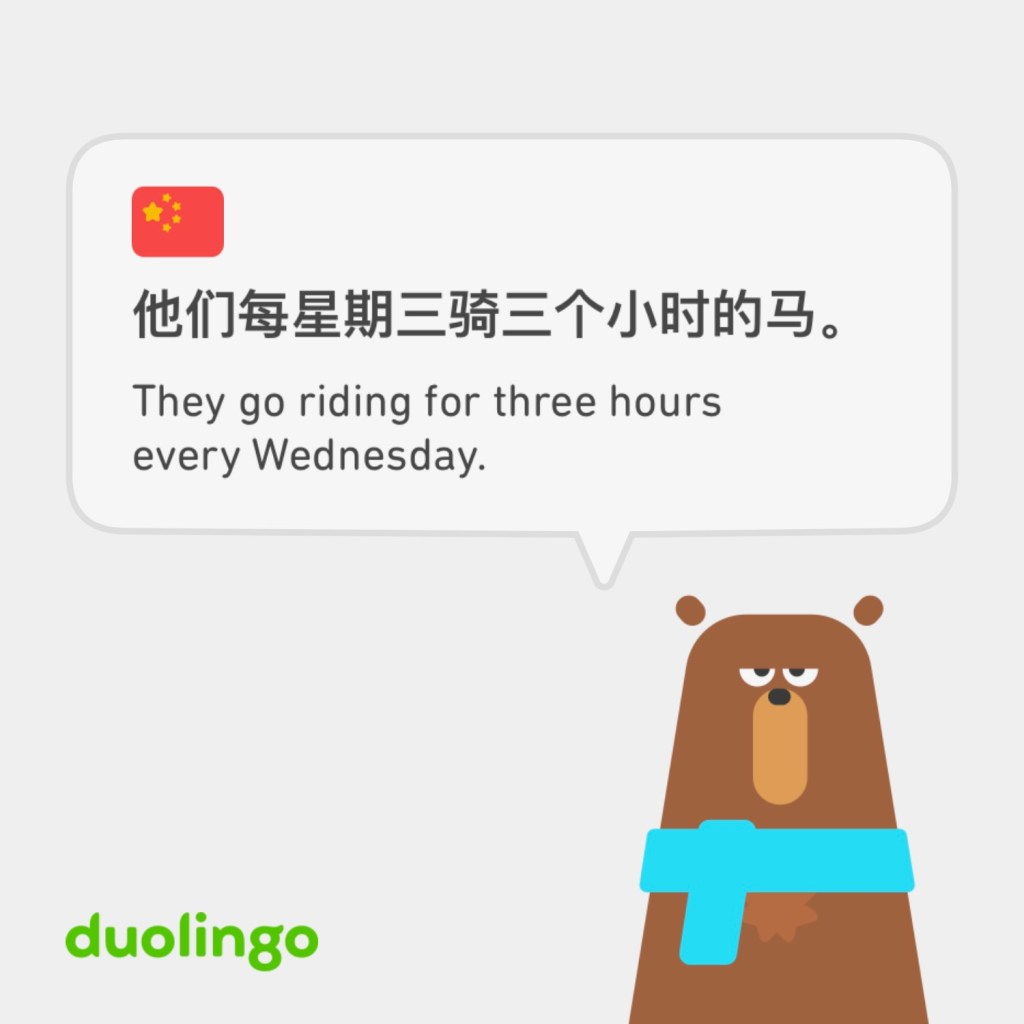
他们每星期三骑三个小时的马。
This sentence (in pinyin, Tāmen měixīngqīsān qí sānge xiǎoshí de mǎ) is from a Section 2 lesson on discussing sports. It’s cute or whatever — translated, it means, “They ride horses every Wednesday for three hours” — but why can I produce this sentence almost from memory? Because I feel like I experienced it so. So. So many times during this unit.
Rather than teaching you grammar, Duolingo Chinese often just repeats the same sentences over and over for you. Instead of clearly presenting notes on language structure and then providing a diverse pool of sentences for you during lessons, the course just throws 他们每星期三骑三个小时的马 at you again and again until you know how to reproduce the sentence the way Duo demands. I’m learning these specific sentences as opposed to the grammar and word choice that make sense in situations like this. It’s a rote conduit for study that continues to be my #1 source of frustration with the course.
What is the point of teaching grammar? For the casual language learner, it must be frustrating getting past the first bits of vocab (here’s how you say “red,” how you say “pencil”) and realizing you’re expected to also learn what nouns and verbs are, where they go in a sentence, conjugation (!), and, depending on the language, a million other nitty-gritty details. And if every language were structured exactly like English, I’d get that frustration. But because no language’s grammar is the exact same as any other (that’s part of what defines a language), learning new grammar is essential to understanding how to put the words you’re learning in conversation with one another. You can’t learn a language only by studying the vocab. So as a language-learning app (and not just a flashcard tool), how does Duolingo Chinese do on teaching you grammar?
Eh.
There are grammar notes, in Duo’s defense. They aren’t great, but they’re there. More often than that, though, for the Chinese course, the actual grammar instruction is minimal. There might be a short explanation on how to use 在 (zài) — once, in one unit. A consolidated spot for these grammar notes appears when you go to select between sections of a course, but not nearly all the grammar notes can be found there, and I dare your average user to find this area. Usually, then, you find no actual notes: just a bunch of example sentences — sentences you’re going to get very familiar with, because they’re presented and re-presented to you all over the corresponding unit.
But to reach these notes, you have to find the little notepad beside the unit name. This may not seem hard, but I’ve had to tell two different people — one learning German and one learning Ukrainian — where to find these notes. I get why they couldn’t find them: the icon blends in on the unit title line. Because the app doesn’t force you to interact with it, it can be easy to forget where the notes section is. I sometimes forgot to look at it when starting a new unit because it is easy to miss (not that the notes were that helpful usually, but still). And this inability to find the grammar notes, or not even knowing they exist, means you go into a unit without any knowledge of how new sentence structures work, making learning exponentially frustrating as you advance.
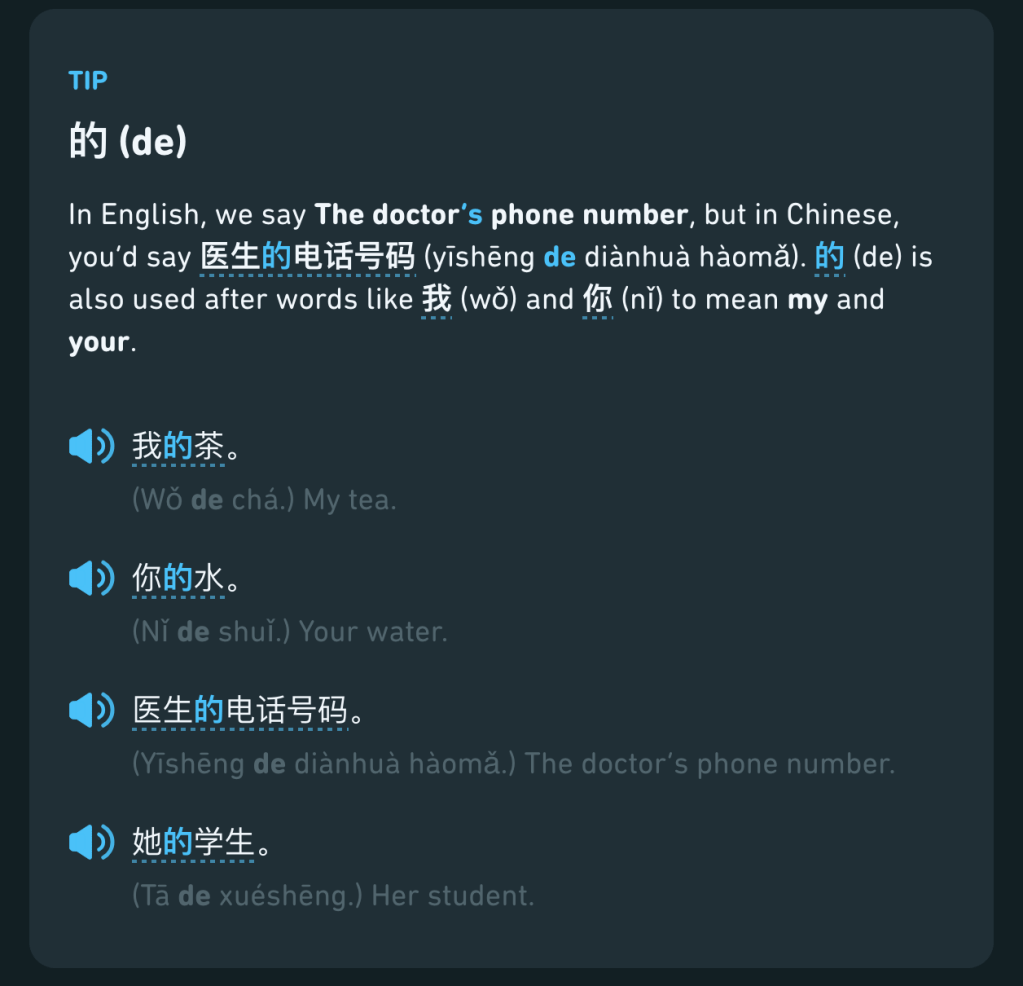
When I experienced 他们每星期三骑三个小时的马 the first few times, I kept getting it wrong. You could argue there’s a bit too much going on here for someone at this point in the course. Sometimes I would miss a word, leaving out the 每个 in 每个星期三 or the 们 in 他们. Sometimes my keyboard would get the character wrong and put 骂 or 妈 in when I typed “ma.” But more often than not, I messed up because I had not been taught the grammar of the sentence. I still cannot tell you, after completing the whole dang course, why the time period is inserted between the verb and object like that (“rides, for three hours, horses”). I can’t tell you why there’s a 的 between 三个小时 and 马, making the time period like an adjective of the noun (“a three hours’ horse”). I still don’t think I had caught on when I first interacted with this sentence that times and dates in Chinese must go around the subject (either before or after), and I’m sure I was putting 每星期三 at the end of the sentence in confusion.
Did Duolingo teach me the grammar? No, not really. Not anywhere I could find it, at least. Unless I looked elsewhere online, I just had to ride that dead, beaten horse for three hours each Wednesday until I got past that unit, and then on to similar arid pastures of bareback memorization with no adequate grammar instruction to saddle up on.
Lesson learned?
Not unrelatedly, I often felt, while going through Duolingo Chinese, that I would begin a new lesson but end with part of another. Within a unit, there was a lack of consistency in sticking to the stated topic. Big parts of individual lessons ended up feeling irrelevant to their broader units.
Each unit has a stated topic: business conversations, discussing hobbies, thinking about the environment, etc. Many times, though, the corresponding lessons devolve from these stated goals. For example, I encountered a lot of weather talk in a later unit focused on chatting with colleagues. These weren’t lessons guiding you through how to talk about the weather with Mandarin-speaking coworkers. Instead, it was just general weather-discussion vocabulary — something that should have been introduced elsewhere earlier.
So many of the lessons are like this, interspersing seemingly random topics — introducing people, giving directions, asking about food — that fall outside either the stated subject matter or the grammar instruction inside the lesson. Duolingo does throw a lot of review into each unit, but this isn’t a case of poorly placed review sentences. This is strictly about new content in a lesson that does not jive with the content around it.
When you set the learner up to think in terms of topics, you’re liable to throw them off when you diverge much from that. When I’m asked to categorize vocab words and contexts and grammatical structures within certain parameters, but then the method dithers off into some other topic, it becomes hard for me to focus and retain information. I can learn colors and numbers if that’s the goal, but Duolingo Chinese throws too many random sentences into the mix to make me feel like I’m headed towards a consistent target.
We exist in the (cultural) context
Near the very end of the course — just a few units away from completion — I came across a business-oriented lesson that introduced the phrase 您贵姓?(Nín guì xìng?). Roughly it means, “What’s your last name?” However, a more literal translation would be, “What is your honorable last name?” And that’s how Duolingo translated 贵姓: “to be honorably last named.” OK — what on earth is that supposed to mean to me, as an English speaker?
Thankfully, I had recently listened to a Mandarin-learning podcast episode discussing this concept. It explained how this was a polite way to ask someone’s family name, which is a more identifier for someone in China than it is in the West (hence why it appears before the given name). That made sense to me. Duolingo, however, presented this phrase without explaining the concept of the honorable last name. It expected you to know it for some reason, or else go elsewhere for aid.
While Duolingo Chinese gives some guidance, there is an appalling lack of cultural notes the farther you go in. It is impossible to know when exactly it’s appropriate to use the informal “you,” 你 (nǐ), or the formal “you,” 您, based on the information Duolingo gives you. When it comes to unfamiliar festivals or foods, you’re better off looking up pictures online then relying on Duolingo’s explanations. Almost nothing is presented about Chinese civic or social life, making it hard at times to see what you’re doing this as anything more than translating the English language and Western norms into Chinese.
I am thankful for the resources I have found outside Duolingo to learn Mandarin, because I would be very confused without them. Having Duolingo be your one-stop shop for language education isn’t realistic, but thinking through the differences in Chinese and American culture is a place where having outside help became especially necessary. Ironically, Duolingo used to have a place where learners could find that kind of resource — until developers got rid of it.
Comments concerns
From the launch of the site, Duolingo allowed learners to leave comments on individual exercises. This is where I often filled the gaps in Duolingo’s instruction with grammar and context notes. I also got so much from following additional links posted by fellow users. However, around two years ago, Duolingo silently removed comments on lessons. This loss not only fragmented the community I had been able to build after almost a decade on the site, but more importantly, it also deleted precious information that helped me get through lessons.
I think a lot of the pain I felt going through Duolingo Chinese would have been alleviated had comments still existed. I went through this course entirely after comments had been removed, but for other courses, I had relied on this outside insight to get through sentences I kept missing, to understand cultural differences, and to discuss hypotheticals in grammar and word usage. Comments from a few top users usually rose to the top based on their proven expertise in the language and community upvotes.
I get that moderating all these comments was probably a massive pain. With all the shifts in its model since 2012, my guess is that newer developers grew to see lesson comments as vestigial. Comments rose engagement, but they also allowed the fledgling site to keep up with problems in its instruction model by outsourcing them to its own users. I did, rarely, run across comments that spread language misinformation, which may have confused learners and made them in turn frustrated with their experience on Duolingo. But in my time on the site and app, I never really experienced much of that — bad info would always be challenged and downvoted.
At the very least, comments were a space where learners could attempt to make up for the inadequacy they faced with Duolingo’s instruction. Now there’s nothing, at least in-app. For the Chinese course, this means Duolingo no longer provides an internal outlet to discuss why you keep missing that character’s meaning or get an answer to why you use 的 in this case but not in another. Though it isn’t clear to me when exactly all users lost comments, in part because of long-standing differences in app models.
Android vs. iOS vs. me
About 90% of the way through learning Chinese on Duolingo, I switched from a Samsung smartphone to an iPhone. I was generally familiar with how developers prioritize the iOS version of their app (and then, eventually, get around to updating the Android version). I was even aware of some of the ways the experience of Duolingo Chinese changed between the two systems, since my boyfriend was learning on an iPhone. Because of that, I think it’s worth mentioning how Android users suffer with this course compared to their iPhone counterparts.
During word bank lessons, learners build sentences from interactive blocks containing words. On iOS, you are able to switch a word around within the sentence by dragging it, even after you’ve placed it in the sentence. Seems pretty inuitive, right? But you’re not able to do that on Android. If you realize after building the rest of a sentence that you forgot to put a word in at the beginning, you have to remove every word that would follow it, put the word you missed in, then replace every word you just took out to complete the sentence.
This inability on Android to switch words during word bank lessons means a lot of time is spent removing and putting back words. This kept happening to me in Duolingo Chinese because time words like 现在 (xiàn zài), which must go near the front of the sentence, were often ones I forgot to add until I had done everything else. Other examples of differences between OS versions include receiving updated versions of a course before Android users, with new features and better voice models.
Now, if you’re an iPhone user — have always been an iPhone user, always will be, turn up your nose at anything Android — then you may wonder why you should care about the plight of us Android users. I would make the case that these differences between operating systems shouldn’t exist in the first place. Why should the experience change between OSs? When the differences lie squarely within the user interface of an app, rather than in a phone’s overall functionality, it signals a rot, a dereliction of one commercially available version of a product for another. And if it can go one way at one point, what’s to say it can’t go the opposite way at another point? It’s unfair, but more than that, it leaves someone like me, who had been using the obviously inferior version of the product, wondering if I would have put up with this course had I known from the outset what a disadvantage I’d been dealt.
The good
I have tried any number of language instruction methods over the years, from traditional classrooms to virtual classrooms to apps to books to podcasts to sites that were probably more viruses than not. As easy as I find it to criticize Duolingo, I recognize that comes in part because I have stuck with it longer than any other method. For me, it’s not just the gamified nature of the learning. It’s also the consistently high quality of the content as well as the digestibility of that content — a five-minute lesson here, a two-minute practice there — that have made Duolingo a mainstay in my educational arsenal.
When I think about other tools I have used to learn foreign languages, including Chinese, nothing quite compares to Duolingo. If I had relied purely on textbooks, I don’t think I would have gained as much mastery of the tones, for example, because by nature, the tones come down to sound. Podcasts can’t really teach the characters, while language-learning blog sites become a rabbit hole for me, miring my senses with an overload of content that can leave me burnt out and exhausted. Duolingo has built something unique, rivaling only the in-person classroom in its ability to make a learner adept at the sounds, spellings, and nuances of a language for so little time and money invested. Not only that, but having my friends cheer me on in the app, sending me XP boosts and congratulating me on accomplishments, is an educational experience comparable only to the classroom.
Duolingo Chinese is awesome for anyone who doesn’t know quite where to start on their Mandarin-learning journey. You will learn all the basics: pronouncing words, putting words together to form sentences, and being able to understand simple sentences in a variety of topics. I was excited to learn, though, just how far the app goes beyond these basics.
Essential character(s)
In 2023, Duolingo announced a big improvement to its East Asian language courses: the addition of character practice. For Korean, this meant being able to practice hangul; for Japanese, practicing all three of hiragana, katakana, and kanji. Likewise, Chinese learners now had a dedicated section for studying the simplified hànzì, the basis for Mandarin as its written in mainland China.
This was huge. Before this update, for both Chinese and Japanese, I had to rely on outside apps and books to practice the complicated characters of each language. There was no way to formalize my knowledge of individual hànzì in app, despite Duolingo using the written language to teach you. The hànzì section lets you see individual characters you’ve learned, get definitions, and practice character stroke order and meaning comprehension. I still have my workbooks and other apps, but having character practice within Duolingo means the app is following along with the characters I’ve learned and allowing me to practice them without having to go elsewhere.

There’s also been the beginning of integration of hànzì practice into the course units themselves. As of March, this was limited to earlier units — I saw these available through Section 2, Unit 6 — and it’s a development being realized after I had already gotten through those parts of the course. However, I expect hànzì practice to continue to be woven into the courses themselves, allowing learners to have a structured focus on one of the most challenging but also integral parts of learning Chinese.
Sound cloud
In Duolingo Chinese, pinyin can appear above the Chinese characters they represent to help users with pronunciation. This is an option you can switch on or off. At first, I never imagined I would be able to switch off this crutch of Latin transileration. About halfway through the course, though, I did mostly keep the pinyin turned off for words I already knew. That’s because Duolingo Chinese is quite good at getting you comfortable with both the different sounds of the language as well as the unfamiliar world of tones.
Like with hànzì practice, Duolingo Chinese has a separate section where you can focus on pinyin (my dirty hint: these less-than-a-minute lessons are a great way to rack up XP). Even now, I am intimidated by the subtle (to my American ears) differences between x and sh or zh and j. This practice section helped me overcome many of my pronunciation fears. It also increased my familiarity with the tones, incorporating them alongside different vowel and diphthong pairings over different lessons.
But even in the main part of the course, Duolingo Chinese emphasizes teaching you pronunciation. Many lessons start by letting you hear how individual words are spoken, then having you pair up words with their pronunciations. I also saw the introduction of more opportunities to speak during lessons, saying sentences and hearing myself test these sounds and tones against the app’s version. Nothing helps me learn vocab quicker than being able to pair up what I’m reading with how I hear it in my head, so being forced to say these words out loud pushed me to recognize character differences. (It also got me to hear just how much more I need to work on the tones.)
When an English speaker learns French, they learn how the written language pairs up with pronunciation. Both are written in the Latin alphabet, with only a few nuances in pronunciation needing to be explained. Mandarin is not nearly so kind. Because there’s almost nothing intuitive for a beginner about how a hànzì is supposed to be pronounced, Duolingo Chinese’s focus on teaching users how to say words allows them to form connections with the written and spoken languages. It also prepares them to be more confident in conversation with real-life Mandarin speakers.
Grammar 警察
So you might have noticed I complained a lot up top about the course’s ability to teach grammar. Well, I still stand by that. But, on reflection on my time in the course, I have to acknowledge that I did get a great basis for Mandarin grammar from Duolingo.
Mandarin and English grammar are remarkably similar, but where they differ can create challenges. I’ve mentioned how time phrases have stricter rules than in English (so instead of saying, “I ran five kilometers in the morning,” it’s more like, “In the morning, I ran five kilometers”). Not too terrible. But something like verb tenses can be deceptive. 我见 (wǒ jiàn) can translate to “I see” (present) or “I will see” (future), depending on the context. Likewise, 我见了 (wǒ jiàn le) pretty clearly translates to “I saw,” but that last part that turned the verb past tense, the particle 了, has much, much more nuance than just being an equivalent to English’s “-ed.” When it appears in a sentence like 这个裤子是太短了 (zhège kùzi shì tài duǎn le), that 了 does not make the verb past tense. And depending on context, even 我见 can mean “I saw.” Tricky!
It may not go to the depth I want, but the course does teach you enough of the grammar to get you to an intermediary level. Duolingo Chinese provides enough variety within its sentence framework, for example, to show you cases where 了 marks the past tense, when it is used for emphasis, and when it indicates a changed state within the sentence. The grammar notes — while not emphasized enough within the course — explain this concept. Not only from instruction, but also from repetition, you’re able to begin to understand this notorious little particle.
I think one of the biggest advantages Duolingo has across its courses is its de-emphasis on teaching you a bunch of set phrases and calling it a day. Mandarin is not a language where an English speaker can just learn “please,” “thank you,” or “where’s the bathroom?” and feel like they’re learning how the language ticks. From counter words (个,杯,只…) to the lack of articles like “the,” there is a lot going against an English speaker picking Chinese grammar up naturally. Duolingo at least gives you the framework to prepare yourself for this grammatical journey — even if it doesn’t put up enough signposts on your route.
Slanguage learners
One of the most charming part of the course came late in my time on it. Duolingo Chinese has a whole unit dedicated to teaching you common internet slang, a feature that I think helps set it apart as a truly contemporary language-learning experience.
I won’t spoil the whole thing, but examples of words you’ll learn include 粉丝 (fěnsī). On its own, it means “Chinese vermicelli,” but online, it’s used to mean “followers,” since it’s pronounced similar to English “fans.” Now, we do have some more instances of Duolingo not giving you quite enough cultural context here — I can guess what Chinese netizens are thinking when they call someone a “village tycoon,” but it doesn’t have a direct English equivalent. On the other hand, the grammar notes do explain the origins of 囧 as a pseudo-emoji, providing fun insight into how Chinese speakers think about their written language.

I sometimes shudder thinking about how English language instructors might teach the uses of “like” that have cropped up over the last few decades — for example, when I take, like, a few seconds to, like, tell you about something that should have happened, like, yesterday. You don’t jump into teaching beginners slang like this, even though it’s everywhere in current language. I was excited and impressed Duolingo decided to engage learners with this aspect of Chinese. Future course updates should dive even more into Chinese slang and dialectal speech to get learners more familiar with the language they’ll hear on the street in different regions.
Conclusion: Getting better all the time
While I focused up top on the negatives, I want to emphasize the benefits I have found learning Chinese on Duolingo. I don’t know of another tool outside a classroom that could have gotten me feeling this confident with the written and spoken parts of the language this quickly. Fluency is always a dicey term to define. Even so, I feel certain in naming what areas of Chinese I am proficient in, and I have an idea of where to take my self-education from here.
And the Chinese course has already changed a lot from when I started it. I went back last week to Section 2 to review how to talk about your house (a unit I already don’t remember existing when I went through that section originally). Lo and behold, there was a podcast episode waiting for me, just like with Duolingo French or German! Along with the integrated character lessons, I think this is a great development for this course. In fact, at this rate, this whole review may be out of date within just a few months — and I don’t see that as a problem.
Nevertheless, if you try any other Duolingo course, you can only return to Duolingo Chinese feeling the course remains half-baked, an unfinished attempt at creating something as holistic as Duolingo Spanish or French. When compared to an app like Babbelfish or Lingodeer, Duolingo reigns supreme for its comprehensiveness, UI, and social aspects. But the app’s strengths overall do not completely assuage the issues faced in this particular course.
If you’re new to Duolingo, though, and you aren’t as prone as I am to be picky, Duolingo Chinese is a fantastic choice for a beginner. You will be surprised at how approachable Duolingo makes the language feel right from the first lesson. By the time you finish the course, you will have touched on every topic from greetings to raising capital for a business project, and the patterns of Chinese grammar will have become intrinsic as you migrate to more intermediate content. So while it could be better, I found that Duolingo Chinese provided me — someone who knew almost nothing about the language coming in — a firm basis to build on and a fun tool to return to, even now, for review.
One last complaint, though: When I finished the very last lesson in the course, I didn’t get any recognition for having finished it. There was no on-screen confetti, no certificate to print out, not even a little Duo graphic to share on social media. Duolingo used to put a lot of fanfare when a user completed a course — no more, it seems. ☹️ What’s up with that? If I were at Duolingo, my first order of business would be to record a video of someone in a Duo suit setting off a party-popper to celebrate a learner reaching their journey’s end. The ball’s in your court, von Ahn.

Update (Apr. 24): This post has been updated to more accurately describe Duolingo’s grammar notes.
 Allen Warren
Leave a comment